In today’s world, most people are constantly thinking.
Thinking about the past.
Worrying about the future.
Overanalyzing everything.
This mental noise pulls you away from the only place where life actually happens—the present moment.
Practices rooted in mindfulness help bring your attention back to the now. In fact, research from Harvard Medical School shows that mindfulness meditation can significantly improve mental health:
https://www.health.harvard.edu/mind-and-mood/mindfulness-meditation-improves-mental-health
And according to Mayo Clinic, meditation can reduce stress, improve focus, and support emotional well-being:
https://www.mayoclinic.org/tests-procedures/meditation/in-depth/meditation/art-20045858
The good news?
You don’t need hours of practice.
You can return to the present moment in just 5 minutes.
Why Most People Struggle to Stay Present
Your mind is designed to think—but it often overworks.
Psychology explains this through concepts like cognitive defusion, which helps you separate from your thoughts instead of being controlled by them.
The American Psychological Association explains mindfulness as the ability to observe thoughts without attachment:
https://www.apa.org/topics/mindfulness
When you don’t have this skill:
- Thoughts take over
- Emotions intensify
- Stress increases
Presence is not about stopping thoughts.
It’s about not getting lost in them.
The Power of the Present Moment
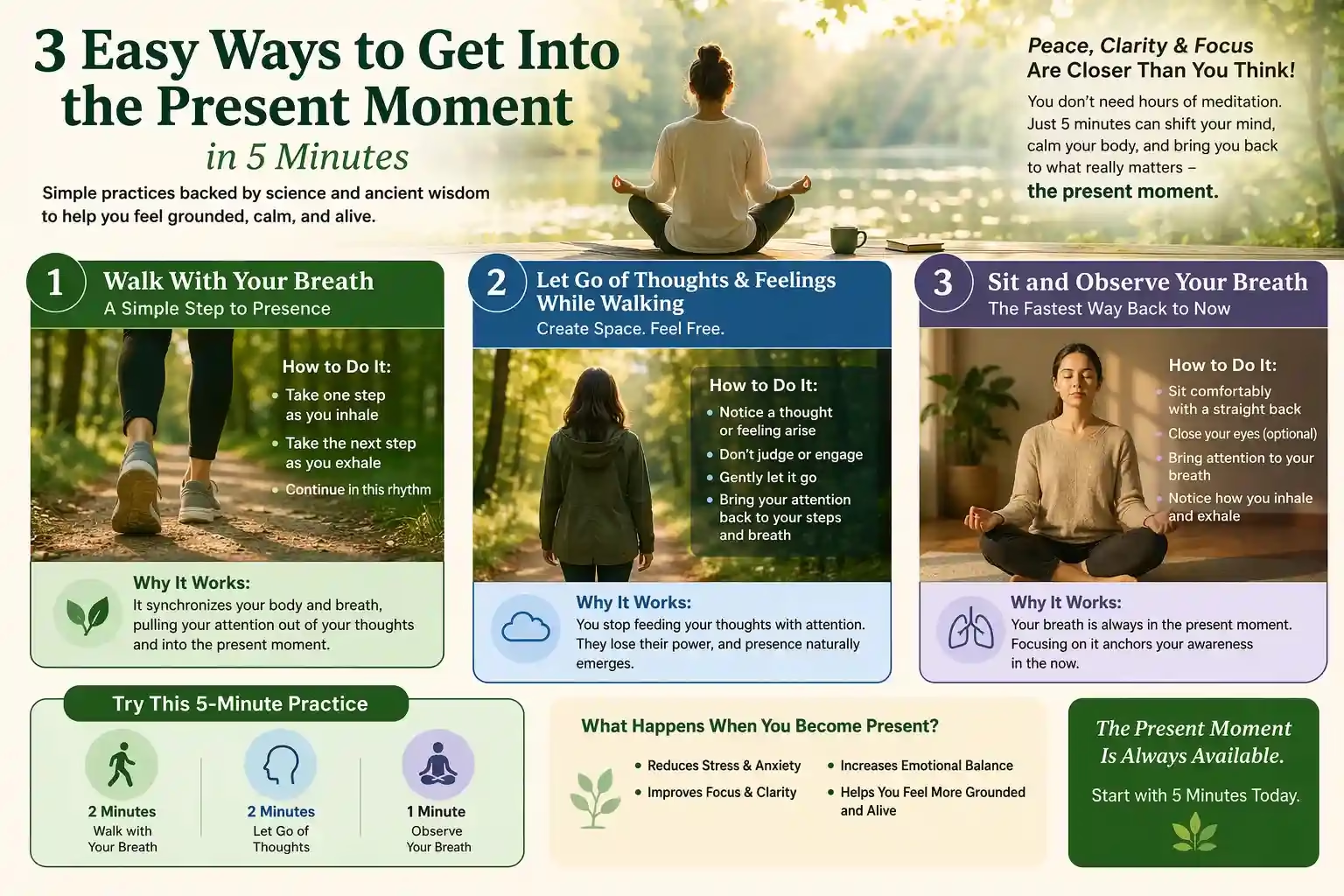
Returning to the present moment creates immediate shifts in your body and mind.
- Your breath slows
- Your nervous system relaxes
- Your awareness sharpens
Research from University of California shows that mindfulness improves brain function and emotional regulation:
https://greatergood.berkeley.edu/article/item/five_ways_mindfulness_meditation_is_good_for_your_health
You can also explore foundational concepts through resources like Psychology Today:
https://www.psychologytoday.com/us/basics/mindfulness
Method 1: Walk With Your Breath
This is one of the easiest ways to enter the present moment.
How to do it:
- Step as you inhale
- Step as you exhale
- Continue slowly
This method is similar to walking meditation practices described here:
https://www.lionsroar.com/how-to-practice-walking-meditation/
Why it works:
It synchronizes your body and breath, bringing awareness out of your mind and into your body.
Method 2: Let Go of Thoughts and Feelings While Walking
As you walk, thoughts will arise.
Let them go.
Instead of engaging, gently return your attention to your breath and steps.
This approach is supported by cognitive defusion techniques:
https://contextualscience.org/cognitive_defusion
Why it works:
You stop feeding thoughts with attention, and they naturally lose power.
Method 3: Sit and Observe Your Breath
Sit quietly and observe your breathing.
That’s it.
Why it works:
Your breath always exists in the present moment.
Scientific research on breath awareness confirms its effectiveness:
https://www.ncbi.nlm.nih.gov/pmc/articles/PMC6137615/
The Science Behind Presence
Mindfulness is not just spiritual—it’s scientific.
Studies show it can:
- Reduce stress hormones
- Improve focus
- Enhance emotional stability
For example, research published by the National Institutes of Health shows mindfulness reduces stress and improves well-being:
https://www.ncbi.nlm.nih.gov/pmc/articles/PMC5679245/
How to Build a Daily Presence Habit
Start small.
Even 5 minutes a day can create change.
If you’re new, follow this beginner-friendly meditation guide:
https://www.mindful.org/how-to-meditate/
Simple 5-Minute Routine
- Walk with your breath
- Let go of thoughts
- Sit and observe your breath
Deepening Your Practice
Presence becomes even more powerful when combined with Reiki and energy awareness.
Explore deeper work here:
- https://reikidome.com/reiki-healing-sessions/
- https://reikidome.com/reiki-training/
- https://reikidome.com/peace-and-vitality-program/
Final Thoughts
The present moment is always here.
You don’t need to create it.
You simply return to it.
Start with 5 minutes today.
That’s enough.
Serving clients in Bellevue, WA (https://www.visitbellevuewa.com/), Redmond, WA (https://www.redmond.gov/), and Kirkland, WA (https://www.kirklandwa.gov/), we provide expert solutions tailored to the unique needs of the Eastside community, with a strong reputation across Seattle, WA (https://visitseattle.org/) and surrounding areas for delivering reliable, high-quality results; if you’re searching for trusted services near Bellevue, Reiki Dome is here to help you achieve lasting results with proven local expertise.