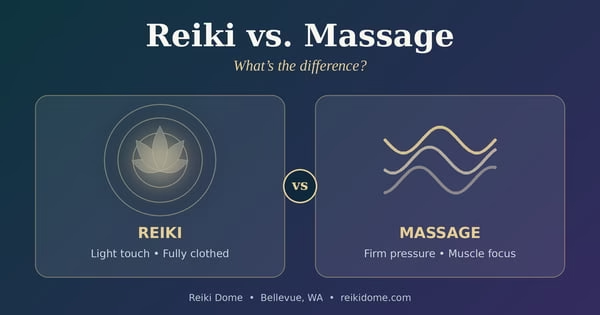
If you are looking for a way to unwind, you may be weighing a massage against a Reiki session. Both can leave you feeling relaxed, but they are quite different experiences. Here is a simple comparison to help you decide.
The Short Answer
Massage is hands-on bodywork. A therapist uses pressure and movement to work on muscles and soft tissue. Reiki is a gentle, relaxation-focused practice that uses light touch or hands held just above the body, with no kneading or manipulation.
Side-by-Side Comparison
| Reiki | Massage | |
|---|---|---|
| What it is | Gentle energy-based practice from Japan | Manual manipulation of muscles and soft tissue |
| Touch | Very light touch or hands just above the body | Firm to moderate pressure, depending on style |
| Clothing | Fully clothed | Usually undressed to comfort, draped with a sheet |
| Sensation | Often warmth, stillness, or deep calm | Pressure, stretching, release in muscles |
| Focus | Relaxation and a sense of balance | Muscle tension, soreness, and circulation |
| Good for | Quiet rest, stress relief, those who prefer minimal touch | Physical tension, stiffness, recovery from activity |
What Reiki Feels Like
During a Reiki session you rest on a comfortable table, fully clothed, while the practitioner works with light touch or hands just above the body. Soft music plays, and most people become very still. Some notice warmth, tingling, or heaviness, and others simply rest or drift into a doze. There is no wrong way to experience it.
New to Reiki? Read our guide to what to expect at your first Reiki session, or see how remote Reiki works if you would rather stay home.
What Massage Feels Like
A massage therapist works directly on muscles with strokes, kneading, and pressure, which can feel firm or even briefly intense in tight spots. Many people choose it for sore shoulders, a stiff back, or recovery after exercise.
Massage is a licensed health care profession in Washington. Therapists are credentialed by the Washington State Department of Health, so ask to see a therapist’s license before you book.
Which One Should You Choose?
Reiki may suit you if you want a quiet, low-pressure hour to rest, you are sensitive to touch or uncomfortable undressing, or you want something gentle that works with limited mobility.
Massage may suit you if your main concern is muscle tightness or physical soreness and you enjoy firm, hands-on work.
You do not have to pick one forever. Some people use massage for physical tension and Reiki for rest and stress, and the two can complement each other.
What Does the Research Say?
Research on Reiki is still limited. The National Center for Complementary and Integrative Health (part of the NIH) notes that there is no scientific evidence for the energy field thought to play a role in Reiki, and that Reiki has not been shown to have harmful effects. The Merck Manual consumer edition likewise says there is not enough evidence to know whether Reiki is effective for conditions such as pain or mood disorders, and that it appears to be safe.
That is why Reiki is considered a complementary practice. Many people enjoy it for relaxation, but it should never replace care from a doctor. Tell your health care providers about any complementary practices you use so your care stays coordinated.
Choosing a Reiki Practitioner
Because Reiki is not a licensed profession, it helps to ask about a practitioner’s training and experience. At Reiki Dome we also teach Reiki classes from introductory level through Master Teacher, so you can learn the practice yourself if you are curious. You can also try a group setting at our Reiki Circle.
Frequently Asked Questions
Is Reiki a type of massage?
No. Reiki uses very light touch or no touch, and there is no pressure or muscle manipulation.
Do I have to undress for Reiki?
No. You stay fully clothed.
Which is more relaxing, Reiki or massage?
It depends on you. Some people find Reiki’s stillness deeply calming, while others prefer the physical release of massage.
Can I get both?
Yes. Many people alternate them, depending on whether they need physical release or quiet rest.
Does Reiki replace medical treatment?
No. It is a complementary practice and not a substitute for medical care.
Can I try Reiki if I cannot visit in person?
Yes. We offer remote Reiki sessions.
Try Reiki in Bellevue
If Reiki sounds like the right fit, Reiki Dome offers sessions in Bellevue at 1611 116th Ave NE, Suite 101, open daily 9:00 AM to 8:00 PM. Explore our pricing and session packages, consider an intuitive reading, then book online or call 425-417-2066.